Is AI revolutionizing mass spectrometry-based analytics?
- IMPROVED DATA PROCESSING, PATTERN RECOGNITION, MOLECULAR NETWORKS, AND PREDICTIVE MODELING
Nina Sipari, Maarit Karonen
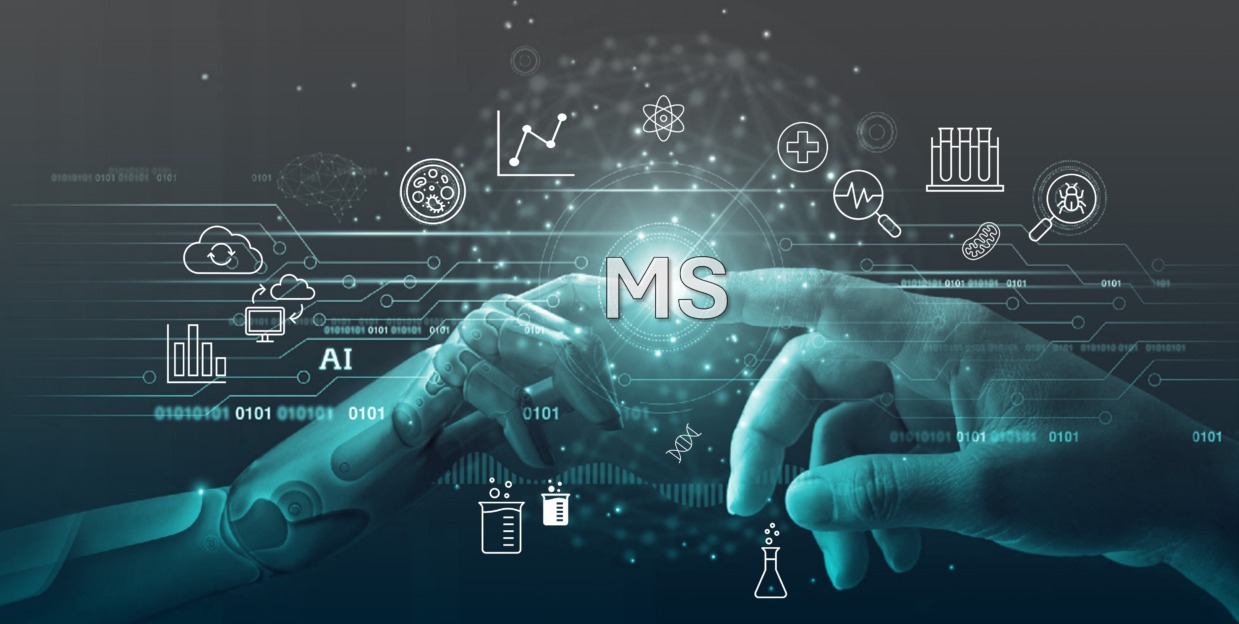
Artificial intelligence has quickly established its role in information retrieval and processing. The magnitude and scope of this change are still difficult to assess, as they are only beginning to unfold, but it seems to be evident that its impact will increasingly extend to mass spectrometric analysis, particularly by facilitating the management and interpretation of big datasets. Therefore, the Finnish Mass Spectrometry Society is organizing a seminar that outlines recent developments and widespread adaptation of machine learning (ML) and artificial intelligence (AI) in the field of mass spectrometry (MS). These recent advancements have created immense new opportunities for both research and technological developments in MS. Integrating the use of AI with MS can revolutionize the field of MS-based analytics by enhancing data analysis, improving instrument performance, and streamlining workflows. With the help of ML and generative language models, researchers can now perform complex and time-consuming tasks more quickly, and use AI as an effective tool for data processing. AI algorithms, particularly machine and deep learning techniques, facilitate the interpretation of complex mass spectra, enabling the identification and quantification of compounds with greater accuracy and processing rate. In addition, AI can be utilized to identify novel biomarkers from large data sets and/or patient cohorts by employing supervised and unsupervised learning approaches to uncover metabolic pathways and biomarkers associated with various diseases.
Session 1: AI in metabolomics and advanced data analysis
In our first session we get insights of how AI is used in the field of metabolomics at the University of Turku: Professor Kati Hanhineva will tell us about Computational and AI-based Approaches in LC-MS Metabolomics studies, while Ilari Kuukkanen will show how Ultrahigh-Resolution Metabolomics and Machine Learning can be utilizedin Precision Diagnostics of Lyme Neuroborreliosis. In addition, Axel Meierjohann from Revvity will tell us how AI can be deployed for Simplified Result Acceptance in a High Throughput Flow Injection Analysis (FIA)-MS Assay.
With the help of AI, researchers can identify new biomarkers (e.g. metabolites, proteins, peptides) with MS which is crucial for diagnosing diseases in clinical trials. Moreover, AI can predict the behavior and interactions of compounds, accelerating the design of new pharmaceuticals and the detection of desired and undesired drug interactions. ML has emerged as a transformative tool in molecular modeling, networking and metabolomics, significantly enhancing the analysis and interpretation of complex biological data and streamlining workflows. In ML, the algorithms can predict molecular properties, reactions and interactions, enabling researchers to design novel compounds with desired characteristics more efficiently. Furthermore, ML models can integrate multi-omics data, providing a holistic view of biological systems and enhancing our understanding of metabolic regulation and molecular networks. Overall, the application of ML in these fields is driving innovation and offering new insights into complex biochemical processes.
Session 2: Mass spectrometry, big data and diagnostics
In our second session, Professor Jean-Luc Wolfender (University of Geneva) will give us a comprehensive insight about Mass Spectrometry and Big Data Analytics: Advancing Natural Product Research through Data Science-Driven Digital Transformation, while Archana Kommala’s talk will focus on Developing Multimodal Approaches for Liver Fibrosis Diagnostics by Integrating Near-Infrared Spectroscopy (NIR) with Lipidomic Profiling (MS) and Histopathology.
Session 3: AI in pattern recognition and MS technology development
As AI-driven predictive models can assist in optimizing experimental conditions and instrument settings, instruments achieve easily higher sensitivity and resolution. In addition, the automation of data processing and the development of intelligent software tools can reduce human error and increase throughput, making MS more accessible for high-throughput applications, for example, in the fields of proteomics, metabolomics, and environmental analysis. Tom Ruane (Sciex) will guide us through how AI can be used in Pattern Recognition in Improving Software Advancements and MS Technology Development.
Session 4: Atmospheric applications and air quality analysis
While MS-based techniques are crucial in the field of life sciences and pharmaceutical industry, AI can also be utilized in atmospheric sciences to improve air quality, developing methods to obtain accurate information about air quality using simple, cost-effective measuring devices. Advanced air quality monitoring equipment can employ AI methods and specific mathematical models to automatically improve the accuracy of measurements through so-called virtual sensors. The results obtained can further be applied, for example, in urban planning and in reducing health risks associated with air pollution. In our last session, Professor Matti Rissanen and Federica Bortolussi from University of Helsinki will show us how Atmospheric New Particle Formation can be studiedthrough Ambient Sampling Chemical Ionization Mass Spectrometry
In the future, the effective and intelligent use of AI in mass spectrometry will not only enhance analytical methods but also promote new innovations and novel applications across various scientific disciplines, and revolutionize the field of MS analytics. The true potential of AI is still ahead of us. The time will show how far we can go.
The seminar “Revolutionizing mass spectrometry-based analysis with AI - improved data processing, pattern recognition, molecular networks and predictive modeling” is organized by the Finnish Mass spectrometry Society (FMSS) on Wednesday April 15th, 2026, at ChemBio Finland 2026 at Messukeskus Helsinki. The presentations are held in English.